Your goals are not a strategy. Learn the 3 elements of a good strategy.

You take a day out of the business. Maybe the team comes along, maybe it's just you. You write down what you want for the year. You call it a strategy/vision day.
🎯 Grow revenue by 20 per cent… Get more leads… Build a better culture… Improve customer service.
It feels good. You type it up and stick it on the wall. Done and dusted.
Then you blink and 3 months has passed. The list of goals are still there, but the business is doing what it’s always done. You've been flat out the whole time, but none of that work has moved you closer to what you wanted.
I've watched this happen time again in businesses I coach, and in my own. The easy explanation is that we didn't execute enough, or the team wasn't up to it. Usually it's neither. What ‘went on the wall’ was never a strategy. It was a list of goals and ambitions.
Most business strategy isn't strategy
I've been reading Good Strategy Bad Strategy by Richard Rumelt, who has spent over forty years advising companies on strategy. Rumelt has argued for a long time that most of what gets called strategy is goals with adjectives attached.
He names a few bad habits when it comes to forming strategy, and all of them turn up in small business:
The first bad habit is fluff. Think big words that sound impressive and say nothing. "We will be the leading provider of customer-focused solutions in our region." As Australians, we call this ‘BS’! And we have a good detector for it.
The second bad habit is not facing the problem. If you can't say out loud what's in your way, you can't get past it. Planning days often skip this part, because naming the problem is uncomfortable.
The third is mistaking goals for strategy. “Grow 20 per cent” is a wish with a number attached. Strategy is how you'll do it, and what you'll stop doing to make room.
The fourth bad habit is the long list of objectives that falls out of a strategy planning day. Every item looks reasonable on its own, but none of them usually touch the real problem. Rumelt calls it a dog's dinner.
Another common flaw with forming business strategy is mixing it up with vision.
Vision still matters, because it tells you which problems are worth solving in the first place. But a vision doesn't produce a strategy on its own. You can have a stirring vision and still not know what to do, because the next move comes from understanding the obstacle, not from wanting the outcome.
Innovation is saying no to 1,000 things.
Steve Jobs
So here's the test. If what you call your strategy is a five-year vision, a mission statement, three values and a revenue target — you've filled in a template. That's fine as far as it goes. It just won't tell anyone what to do.
The three parts of a real strategy
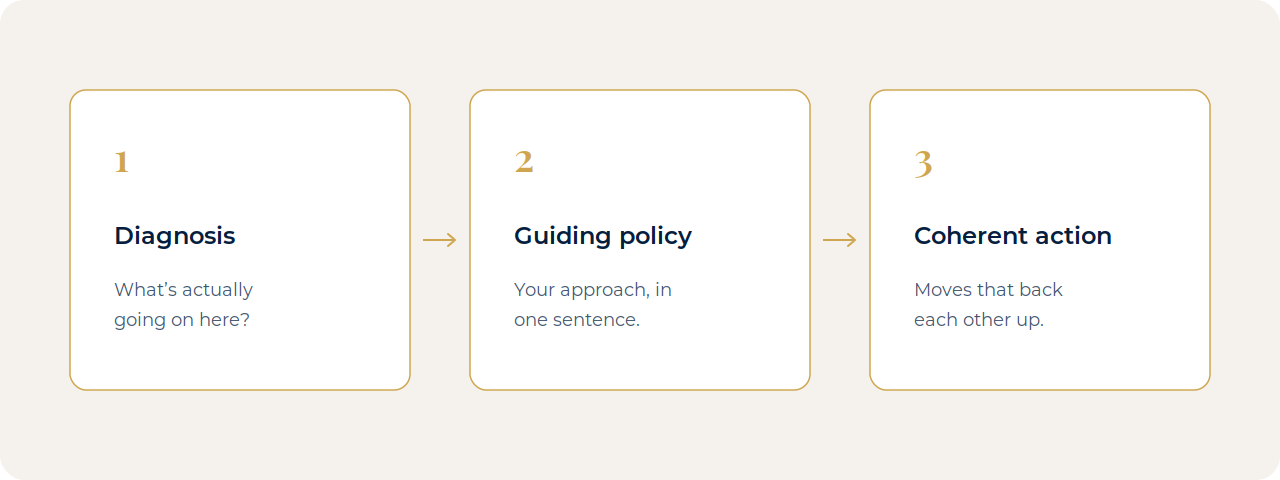
Rumelt calls the core of a strategy the kernel. It has three parts: a diagnosis, a guiding policy, and coherent action.
A diagnosis answers the question, what's actually going on here. A guiding policy is your approach to that problem, in a sentence. Coherent actions are the moves you design to back the policy up.
Apple in 1997 paints a good example of how strategy can be used to turn a company around. In this case, Steve Jobs had just returned to Apple as it was running out of cash, with a product range nobody could explain. Apple was in dire straights, trying to do everything and compete with giants IBM and Microsoft.
The diagnosis was a cash crisis on top of a sprawling product line. The guiding policy was to cut back to a core that could survive, then wait for the next big thing in tech. The action followed: fifteen desktop models down to one, every portable down to one laptop, printers and peripherals gone, distributors culled, manufacturing moved offshore, thousands of jobs cut.
Click play below to watch Jobs himself explain his strategy in a minute:

Rumelt interviewed Jobs the following year and asked how Apple could ever beat Windows and Intel. Jobs said he was going to wait for the next big thing.
With less products to focus on, they released a new iMac which became a hit. Then the iPod soon thereafter. Then came the iPhone, and the rest is history.
Apple’s success started with a brutal survival strategy. When Apple was haemorrhaging cash, Jobs didn't waste any time nailing down to a strategy. He looked honestly at the problem (the diagnosis), picked one approach, and forced every action to focus in one direction.
Step 1: Diagnose the real problem
The first part of Rumelts strategy kernel is a diagnosis. It’s vital to name the thing standing that stands between you and where you want to be. Not the symptom. The root cause underneath it.
“Cashflow is tight” is a symptom. “We keep taking small jobs that cost more to quote than they earn” is a diagnosis.
“The team isn't performing” is a symptom. “Nobody knows what success looks like in their role” is a diagnosis.
If you get stuck, run the five why’s strategy. Keep asking until the answer stops being a symptom.
Step 2: Choose a guiding policy
Once you know the problem, choose your approach. Rumelt calls this the guiding policy. It isn't a goal and it isn't a to-do list. It sits in between, like a signpost. It gives you the direction without spelling out every turn.
Take the diagnosis above from a local business, that small jobs are eating your margin. A guiding policy might be: “We move upmarket. We only quote work above a certain size, and we build relationships with the few people who buy or refer at that level.”
Notice what that does. It rules things out. It tells your team what to say no to when you're not in the room.
That's the test of a good guiding policy. It makes some options obviously wrong. If nothing is ruled out, you don't have a policy, you have anything goes, and your time and money end up spread thin.
Step 3: Commit to coherent action
Coherent action means your actions work together and back each other up.
Rumelt breaks it into three things: policies that don't fight each other, resources actually committed, and actions built to carry out the policy rather than to look busy.
Most businesses have a long list of ‘priorities’ that contradict each other. They don’t stack up to achieve the guiding policy. And therefore, there’s no implementation of strategy.
Back to our upmarket example. Coherent action could look like lifting your minimum job size, rewriting the website for that buyer, and spending time each week with referral partners who work at that level. Incoherent action looks like doing all of that, and still running discount ads for small jobs, and still saying yes to the cheap enquiry because it's easier than saying no.
There's a resourcing side too. A real strategy changes your calendar and your budget. Sometimes it changes people's roles. If nothing about your week looks different, nothing has been decided.
So run every action past one question. Does this serve the guiding policy? If yes, resource it properly. If no, park it.

What’s your strategy?
Remember the kernel when you go about setting a strategy for your business: A diagnosis, guiding policy, and coherent action.
Strategy isn't about doing more. It's deciding what you'll do about one real problem, and what you'll give up to do it properly. That giving up part is why most people stop at just setting goals. Goals are important as part of breaking down your vision and direction, but setting goals without an overarching strategy will leave you spinning your wheels.
The business owners I meet are good at setting goals. What they're missing is a strategy to reach them.
Listen to this Insight on My Business Guide, Episode 29. If you want to go deeper, start with the book: Good Strategy Bad Strategy by Richard Rumelt.
If you're a Leader Guide coaching client, bring this to our next session and we'll build it out together. If you're not yet and you'd like help getting clear on your strategy, book a short discovery call here.
Written by Lachlan Nicolson.
Small Business Coach at LeaderGuide.