Why every business owner should consider working with a business coach — and what the process actually looks like.

Running a small business is one of the most rewarding things you can do. It's also one of the hardest. It takes resilience, grit, and the ability to keep showing up — even when things aren't going to plan. The owners who go the distance aren't just the ones who work the hardest. They're the ones who invest in the right inputs to keep their mind sharp, their energy renewed, and their direction clear. That's where a great coach comes in.
A great business coach doesn't give you all the answers, rather, they help you find them. They help you build your awareness, confidence and hold you accountable to the actions that matter. Coaching one of the best investments you can make for your personal growth and for your business.
At the time of writing, I've been Coaching small business owners for 7 years. Here's why every Australian business owner needs a Coach alongside them:
1. A Coach Brings a Different Perspective
You can't read the label from inside the bottle. When you're deep in your business, you can miss what's right in front of you. Problems that would be obvious to an outsider become invisible because you're too close to them. You stop questioning why things are done a certain way. And without even realising, you assume your blind spots don't exist.
A coach sits outside the bottle. They see the patterns you've normalised and can ask the questions you've stopped asking yourself. Regular coaching conversations bring things to the surface, in a safe environment where you can recognise problems early and adjust your course — before you find out the hard way. Having that outside perspective is worth more than most owners realise until they've experienced it.
2. A Coach Changes Your Environment
Your environment is shaping you, whether you choose it or not. As the old adage goes, you become like the people you surround yourself with. If everyone around you is cautious, you'll stay cautious. If everyone is thinking small, it's very hard to think big.
Most business owners spend their days surrounded by their employees, suppliers and customers — none of whom are thinking about the business the way you need to as the owner. A coach creates a different environment to sit in. A space where bigger thinking is normal, where your goals aren't too ambitious, and where someone is actively challenging you to grow.
You've likely felt this before — at a conference, a mastermind, or even travelling abroad. People and places can cause you to think differently and return with a new perspective. A coaching relationship creates that same environment at a micro scale and regular basis. No offsite required.
3. A Coach Turns Intentions Into Action
Accountability is often the missing piece for business owners who want to move faster. We all have a list of things we know should get done but haven't. The strategy that never gets written. The difficult conversation that keeps getting delayed. The system that would save hours every week but never gets built.
Knowing what to do is rarely the problem. Doing it consistently is.
A coach creates a layer of accountability. When you know someone is going to ask you about it next week, you're more likely to do it.
Research backs this up too. You're far more likely to follow through on something when you've committed it to another person, and even more so when there's a scheduled conversation around it. A coach provides both. They're not just someone to talk to, they're someone you're answerable to. That changes how you show up between sessions.
How Coaching Works at Leader Guide
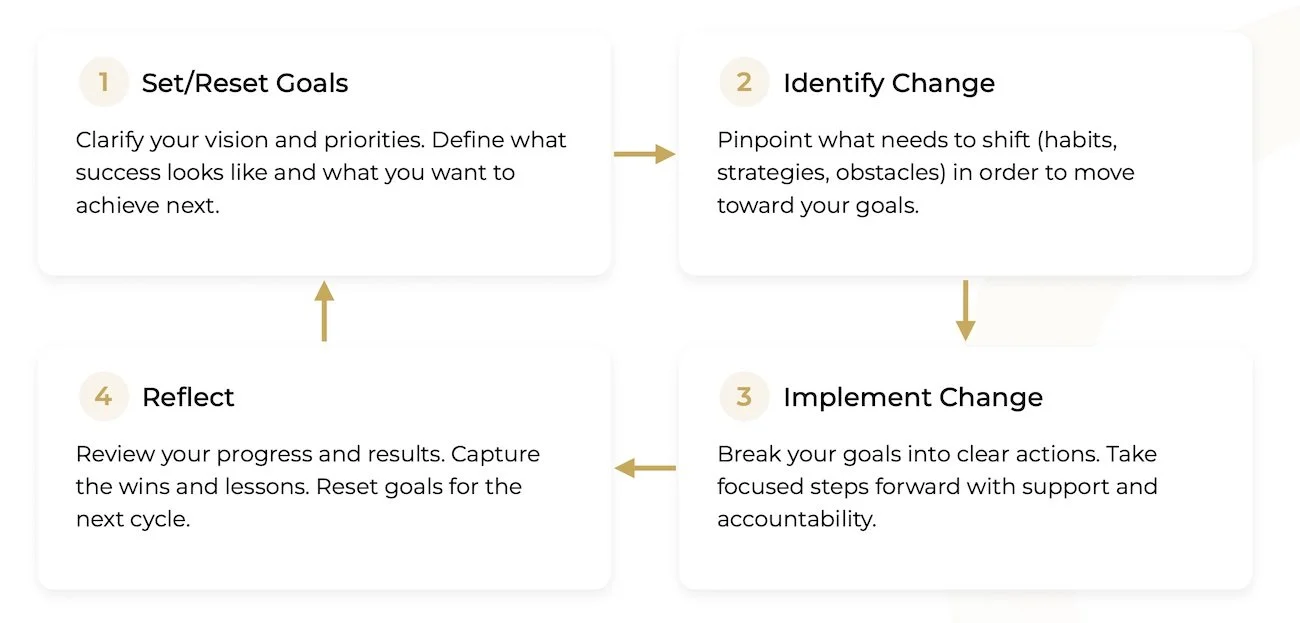
Coaching is more than discussion. It's a structured process that incorporates questions, tools and frameworks to help you unlock real growth. At Leader Guide, we follow a four-step cycle to keep each coaching conversation moving you forward.
1. Set/Reset Goals — Clarify your vision and define what you want to achieve next and what does success looks like. Every cycle starts with getting clear on what matters most right now.
2. Identify Change — Pinpoint what actually needs to shift to get there. That might be a habit, a strategy, or an obstacle that keeps getting in the way.
3. Implement Change — Break your goals into clear actions and take focused steps forward with support and accountability alongside you.
4. Reflect — Review your progress, capture the wins and lessons, then reset for the next cycle.
Two frameworks we weave into this process are the Leader First Mindset — helping owners shift from doing everything themselves to actually leading their business — and the Offload Loop, which helps owners stuck in the grind reclaim their time and energy before burnout takes hold.
In addition to Coaching, which coaching helps you think and plan, we also offer consulting services for expert, hands-on implementation — so nothing gets left on the whiteboard.
Written by Lachlan Nicolson.

Why risk going alone?
You probably know its time to engage a Coach, but you've been putting it off nonetheless. My encouragement is to take the first smallest step towards it. We've made it simple for you: Take our initial coaching questionnaire.
This questionnaire will help you clarify why you want to engage a Coach and what would be the parameters for success. Then you can book a free call with us to continue that conversation.
Listen to My Business Guide on Apple & Spotify