Problems aren't getting in the way of the work. They are the work. Here's a simple loop to lead through them.
Here's something nobody tells you when you start a business. The smooth days, where nothing goes wrong and the sun's shining, are the exception. Not the norm.
Most days, there's problems. A deal goes quiet. A staff member calls in sick. Your CRM stops syncing and you can't figure out why. Your best salesperson resigns at 4pm on a Friday. And is the BAS due again? Didn't I just pay that?
For years, I treated every problem like an interruption, or worse, a sign of failure. As if the real work was somewhere on the other side of the problem.
Then I realised it isn't. If you're a business owner, the problem in front of you is the work.
Problem solving is the business you're in
Your customers pay you to solve their problems. Your products and services do that on repeat. Then there are the problems inside your business: how you deliver, how you operate, and how you keep up as things change.
And a bigger business doesn't mean fewer problems. It just means bigger ones. If your answer to problems is to just grow, you're setting yourself up for disappointment.
The owners doing well aren't the ones with fewer problems. They've just learned how to handle problems better.
So think about the last problem that hit you. What did you do in the first few minutes? Did you lean in? Overthink it? Complain about it? Ignore it? Or dump it on your team?
Good stress, bad stress
Stress gets a bad name, but not all of it is bad. Here's what the research has found over the years:
1908: Psychologists Robert Yerkes and John Dodson found that a bit of pressure lifts performance. Too much, and it drops off a cliff.
1970s: Hans Selye coined the word eustress for good stress: the kind that wakes you up and sharpens you.
More recently: Alia Crum at Stanford found that people who see stress as useful tend to handle it better.
The same adrenaline that makes you sigh in disbelief can also make you sharper. The difference is what you do with it.
Worry is different. It's wasted energy, a roller coaster on a loop. It goes round and round and gets nowhere. If you're stuck in worry, you need a way forward.
We suffer more often in imagination than in reality. - Seneca
The LEAD Loop
There are plenty of problem-solving models out there: IDS, PDCA, the OODA Loop, Toyota's 5 Whys. At Leader Guide we use the GROW coaching model. Back in 1945, maths professor George Pólya wrote How to Solve It, with four steps: understand the problem, make a plan, carry it out, and look back.
I've pulled these ideas together into a short framework built for business owners. It's called LEAD:
The LEAD Loop
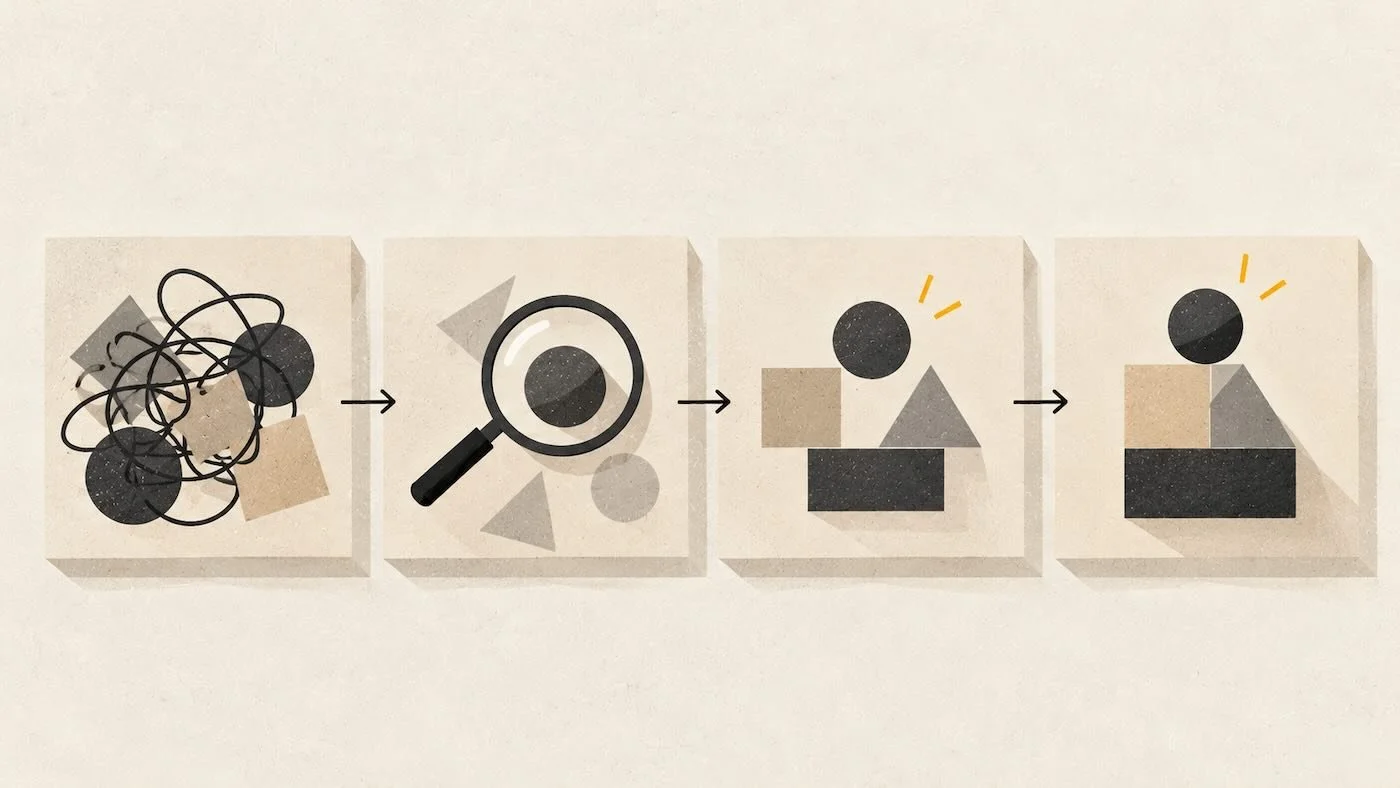
- Listen to what's really going on.
- Examine the real problem below the surface.
- Act by breaking it down to the next smallest step.
- Debrief to learn and improve each time.
It's a loop because every problem you solve should make you a little sharper. But you never graduate from it. You go back to step one and keep your ear out for the next problem.
Step 1: Listen
Listening is a lost art. When a problem lands, most of us react to the first thing we hear. A customer complains about price, so we assume price is the problem. A team member is short with us, so we assume it's attitude. Often neither is true.
Listening means being present to the problem before you try to fix it. As Stephen Covey put it, seek first to understand. Listen in four places:
Yourself. What am I feeling, and is it telling me something useful?
Your people. What are those closest to the problem saying?
Customers. What are they actually asking for? Don't assume.
The numbers. What does the data say, as opposed to the loudest voice?
A simple habit to start with: before you respond, write down what happened in one sentence. Just the facts. The sentence is often smaller than the feeling. I've done this with a coaching client who was close to a panic attack. Once we wrote it down and confirmed the facts, they felt a lot better, and soon had a plan in motion.
Step 2: Examine
The first problem you see is usually a symptom. Examine is where you dig under the surface. I use a few coaching questions borrowed from GROW:
What's actually happening? Facts, not feelings.
Why is it happening? Ask that a few times.
What's mine to fix, and what isn't?
What would "solved" look like? Sometimes this shows expectations were never met, or never set.
Say your quotes keep going out with mistakes. Why? The team keeps missing items. Why? There's no template. Why? I've always done quotes in my head. Suddenly the problem isn't the team's attention to detail. It's my system. (More on this in the 5 Whys strategy.)
The goal is clarity, not blame. Some things are out of your control, like interest rates, the weather or a supplier going under. Sort that out early and put your energy into what you can change.
One more question: have I seen this before? Most problems aren't new. They may be new to you, but not to someone else. That's why it pays to have a community of business owners to ask.
Step 3: Act
Once you know the real problem, do something about it. Keep it small to start, so you get momentum, not overwhelm.
I see owners go one of two ways here. Some freeze, because the problem feels too big. Others overreact: one bad Google review and suddenly they're rebuilding the whole customer journey.
Don't make a mountain out of a molehill. Make the phone call. Send the email. Book the meeting. Change one part of the process. Most problems get solved through a few small attempts, not one perfect decision.
It's easy to stall because we think of all the ways it could go wrong. But things can also go extremely well. What if we shoot for the moon and hit it?
Then find someone to keep you accountable to that next step. That's a big part of what a coach does. Learn more.
Step 4: Debrief
This is the step almost everyone skips. The fire's out, you're tired, and there's another one waiting. But if you don't debrief, you'll solve the same problem again next month.
Pilots debrief after every flight, good or bad. The army calls it an after-action review. In whatever format suits, ask what worked, what didn't, and what you'd change next time. It's also a chance to thank the people who helped solve it.
Debrief even when the fix failed. Be gracious to yourself, but still do it. The best lessons come from what didn't work, or only half worked.
Then turn the lesson into something you can use again: a checklist, a better template, a rule or an automation step.
LEAD in action: the client who pays late
Here's a simple problem run through the loop. A client's invoice is 45 days overdue, and it's not the first time.
Listen. I'm annoyed, and a bit anxious about cash this month. The facts: one invoice, $4,800, 45 days late. Third time this year.
Examine. Why does this keep happening? I don't take a deposit. My terms are vague. And I don't follow up until I'm already cranky. So most of this is mine to fix. Success looks like being paid within 14 days, every time.
Act. I'll call them today, not send an angry email. Then I'll follow up with a summary and a payment link. For their next job, I'll ask for 50% upfront.
Debrief. The lesson: I've been acting like a bank. The fix: a deposit on every job over $2,000, clear terms on every quote, a tight final payment date, and automatic Xero reminders at 7 and 14 days overdue.
Leading through problems
Next time a problem lands, picture the word LEAD scrolling across your mind, like a heads-up display.
It's a reminder that we're leaders. We have agency, and we can choose how we respond to problems, big and small, in the good times and the bad. Every problem we learn to solve is a chance to grow, as leaders and as a team.
Listen to this Insight on My Business Guide, Episode 30.
If you're a Leader Guide coaching client, bring a problem you're stuck on to our next session and we'll run it through the loop together. If you're not yet and you'd like help with the bigger problems in your business, book a short discovery call here.
Written by Lachlan Nicolson. Small Business Coach at LeaderGuide.